
Core Personality Profile
Agreeableness: High.
You are high in agreeableness, the primary dimension of interpersonal interaction in the Big Five personality trait model. The two aspects of agreeableness are compassion and politeness.
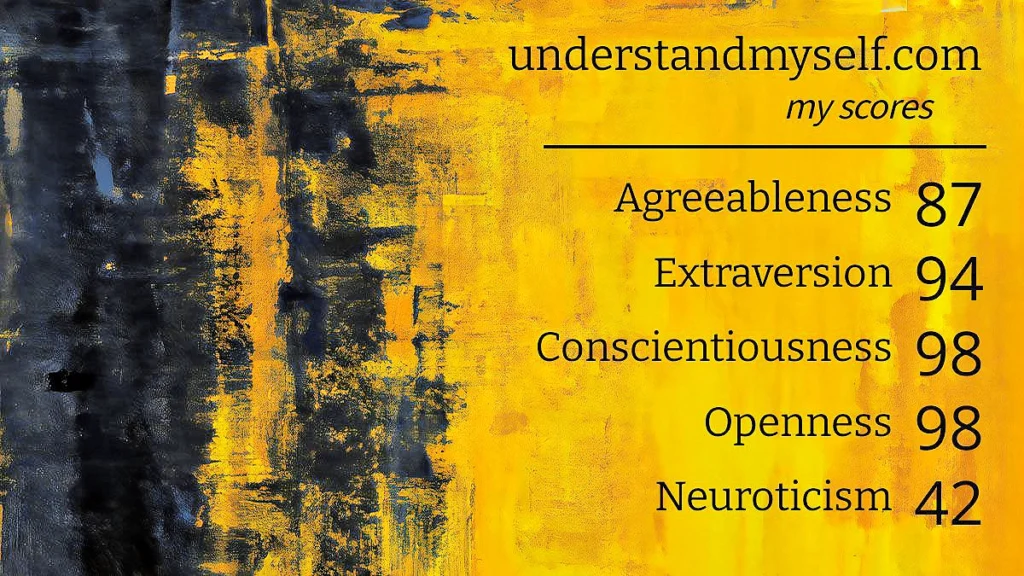
Your score puts you at the 87th percentile for agreeableness. If you were one of 100 people in a room, you would be higher in agreeableness than 87 of them and lower in agreeableness than 12 of them.
People high in agreeableness are nice: compliant, nurturing, kind, naively trusting, and conciliatory. However, because they tend to avoid conflict, they often dissemble and hide what they think. People low in agreeableness are not so nice: stubborn, dominant, harsh, skeptical, competitive, and, in the extreme, even predatory. However, they tend to be straightforward, even blunt, so you know where they stand.
Others see people with high levels of agreeableness as cooperative, warm, and considerate. They are quite likely to look for, and even sometimes see, the best in others, and are interpersonally tolerant (an attitude that agreeable people much value). They do not like to see other people’s feelings get hurt, and tend to be much concerned about the emotional state of others, preferring peace and harmony. They tend highly towards submissiveness rather than dominance (particularly if also above average in neuroticism).
People with high levels of agreeableness are forgiving, accepting, flexible, gentle and patient. They feel pity for those who are excluded, punished or defeated. They tend to insist that people work cooperatively, and often believe that competition, with its losers and winners, is morally wrong. However, highly agreeable people can be taken advantage of, particularly by disagreeable people, including those with criminal or predatory intent.
They will lose arguments (or even avoid discussions) with less agreeable people. They tend not to be very good at bargaining for themselves, or at negotiating for more recognition or power. Furthermore, because they tend to avoid or reduce conflict, highly agreeable people may sacrifice medium- to long-term stability and function for the sake of short-term peace. This can mean that problems that should be solved in the present accumulate counter-productively across time.
Women are higher in agreeableness than men. The mean percentile for women in a general population (women and men) is 61.5. For men, it is 38.5. The fact that men are lower in agreeableness than women helps explain their much higher rates of criminal incarceration (90% male). The primary difference between criminals and non-criminals is disagreeableness. If the typical criminal is more disagreeable than 98% of people in the general population, then almost all those criminals will be male.
Agreeableness, per se, is not strongly associated with political liberalism or conservatism, but this is because the aspects of agreeableness predict such political belief in opposite ways, and cancel each other out. Liberals are higher in the aspect of compassion, and conservatives in the aspect of politeness.
However, alliance with the category of belief that has come to be known as politically correct is strongly predicted by agreeableness (particularly compassion). What this appears to mean is that agreeable people strongly identify with those they deem oppressed, seeing them, essentially, as exploited infants, and demonize those they see as oppressors, seeing them as cruel, heartless predators.
Agreeable people, caring as they do for others, are more likely to enter professions associated with people, such as teaching and nursing, which women dominate. This is true even in the Scandinavian countries, where attempts to produce gender-equal societies have reached a maximum.
Disagreeable people, by contrast, appear to prefer systematizing over empathizing, and are more interested in things – machines and technology. In consequence, professions such as engineering and trades associated with construction and machinery tend to be dominated by relatively disagreeable men.
Compassion: Exceptionally High.
You are exceptionally high in compassion. Compassion is an aspect of agreeableness. The other aspect of agreeableness is politeness.
Your score puts you at the 96th percentile for compassion. If you were one of 100 people in a room, you would be higher in compassion than 96 of them and lower in compassion than 3 of them.
Exceptionally compassionate people are primarily interested in the problems and concerns of other people, and other living things, particularly if they are young or helpless. They are extremely concerned with helping other people avoid negative emotion. They minimize conflict wherever possible. They constantly make time and do kind things for others, even when doing so interferes with fulfilling their own needs and interests.
They have a remarkably soft side. Other people consider them sympathetic and nice, and will turn to them remarkably often for a listening ear. They are extremely empathetic and caring. However, because they are so other-oriented, they find it remarkably difficult to negotiate on their own behalf, and may not get what they deserve (for their hard work, for example).
Those who are liberal, politically, score somewhat higher in compassion than conservatives.
Women are also higher in compassion than men. The mean percentile for women in a general population (women and men) is 61. For men, it is 39.
Politeness: Typical or Average.
You are typical or average in politeness. Politeness is an aspect of agreeableness. The other aspect of agreeableness is compassion.
Your score puts you at the 52nd percentile for politeness. If you were one of 100 people in a room, you would be higher in politeness than 52 of them and lower in politeness than 47 of them.
Typically polite people can be deferential to authority, but can also be challenging, when necessary. They are not particularly obedient. They can be respectful, but will also push back if pushed. They are not made uncomfortable by the necessity of standing up to other people. Typically polite people will avoid conflict reasonably, but are not completely averse to confrontation.
Those who are liberal, politically, score somewhat lower in politeness than conservatives (the opposite pattern is seen with compassion).
Women are higher in politeness than men. The mean percentile for women in a general population (women and men) is 59. For men, it is 41.
Conscientiousness: Exceptionally High.
You are exceptionally high in conscientiousness, which is the primary dimension of dutiful achievement in the Big Five personality trait scientific model. Conscientiousness measures obligation, attention to detail, hard work, persistence, cleanliness, efficiency, and adherence to rules, standards, and processes. Conscientious people implement their plans and establish and maintain order. The two aspects of conscientiousness are industriousness and orderliness.
Your score puts you at the 98th percentile for conscientiousness. If you were one of 100 people in a room, you would be higher in conscientiousness than 98 of them and lower in conscientiousness than 1 of them.
Exceptionally conscientious people are extremely dutiful. They are sloggers. They are made extraordinarily uncomfortable by inactivity. They work remarkably hard and hate wasting time. They are extremely unlikely to procrastinate (particularly if they are also below average in neuroticism).
If an exceptionally conscientious person promises to do something, they will do it, regardless of circumstances, and without finding excuses. They are extraordinarily decisive, neat, organized, future-oriented, and reliable. They are not easily distracted. Other people may think of them as excessively focused on achievement, productivity, and order.
Exceptionally conscientious people are extremely likely to obtain higher grades in academic settings (particularly if they are also intelligent), and make extremely good administrators and managers. They must have everything in its proper place, however – which has advantages and disadvantages – and are likely to be obsessed with detail.
They do things exactly by the book. Exceptionally conscientious people are remarkably prone to guilt (although they are extremely likely to organize their lives so that they have little to feel guilty about). Extremely conscientious people are also extraordinarily susceptible to shame, self-disgust and self-contempt.
Exceptionally conscientious individuals can react catastrophically to failure (particularly if they are also above average in neuroticism). They are extremely judgemental and are easily disgusted by their own moral transgressions, as well as those of others. They suffer extreme shame and guilt when unemployed or otherwise unoccupied, even when that occurs through no fault of their own. Extremely conscientious people are exceptionally committed to personal responsibility.
They are absolutely convinced that those who work hard should and will be rewarded, and that those who don’t work hard and strive deserve their failure. They can be hyper-concerned with hygiene, moral purity, and achievement. They can be very micro-managing and controlling. Exceptionally conscientious people are much more likely to be political conservatives, rather than liberal (particularly if they are also low in openness).
Women are very slightly more conscientious than men. The mean percentile for women in a general population (women and men) is 51.5. For men, it is 49.5.
Industriousness: Exceptionally High.
You are exceptionally high in industriousness. Industriousness is an aspect of conscientiousness. The other aspect of conscientiousness is orderliness.
Your score puts you at the 97th percentile for industriousness. If you were one of 100 people in a room, you would be higher in industriousness than 97 of them and lower in industriousness than 2 of them.
Exceptionally industrious people are extremely likely to be successful in school and in administrative and managerial positions (particularly if they are intelligent). They live to work, and always have to be doing something useful. They do not at all like to sit around.
They are extremely dutiful. They never put things off. They do not mess things up. They always finish what they start, and they do it on schedule. They are always obsessed with accomplishing more in less time, with fewer resources. They have exceptional focus.
Exceptionally industrious people are extremely likely to judge shirkers or people who are incompetent harshly, and to want them out of the way. They are extraordinarily likely to believe that people fail because they don’t apply themselves or work hard enough.
They feel extremely guilty, rapidly, if they do not do their duty. However, because they always stay on or ahead of schedule and accept their responsibilities, they rarely experience actual guilt. They cope remarkably badly with enforced leisure or unemployment.
Those who are liberal and those who are conservative appear equally industrious.
Men are slightly more industrious than women. The mean percentile for men in a general population (women and men) is 51.5. For women, it is 49.5.
Orderliness: Exceptionally High.
You are exceptionally high in orderliness. Orderliness is an aspect of conscientiousness. The other aspect of conscientiousness is industriousness.
Your score puts you at the 97th percentile for orderliness. If you were one of 100 people in a room, you would be higher in orderliness than 97 of them and lower in orderliness than 2 of them.
Exceptionally orderly people are extremely disturbed and disgusted by mess and chaos. They keep everything extraordinarily tidy and organized. They think in remarkably black-and-white terms: things are good or bad, acceptable or unacceptable, with no grey areas.
They make and stick to schedules. They like everything exactly where it should be – and very much want to make sure it stays where it belongs. They are remarkably detail-oriented and, in the extreme, obsessive.
They are extremely rule-abiding, and insist that rules are scrupulously observed. They can be very judgmental, harsh and punitive towards themselves and others if and when rules are broken or procedures ignored. They cannot live without routine and predictability. They can be extraordinarily good at ensuring that complex, sensitive processes are managed properly and carefully.
Excessive orderliness can also constrain creativity (even among those high in openness), as creative endeavors often require mess, disruption, and intervening periods of chaos. Those who are exceptionally orderly are remarkably more likely to be political conservatives. Orderliness is the second-best predictor of conservatism, after openness.
Women are more orderly than men. The mean percentile for women in a general population (women and men) is 54.5. For men it is 45.5. This may account for some of the trouble in relation to housework between women and men. Since women are, on average, more orderly, household disorder will trigger disgust and discomfort in them faster.
This may happen with sufficient frequency so they end up doing a disproportionate share of such work (even though if they waited a bit longer, their less orderly partners, often men, might end up equally troubled and motivated to fix the problem).
Orderly people are more likely to have items such as event calendars, drawer organizers, laundry baskets, irons, and ironing boards in their immediate environments.
Extraversion: Very High.
You are very high in extraversion, which is the primary dimension of positive emotion in the Big Five personality trait scientific model. Extraversion is a measure of general sensitivity to positive emotions such as hope, joy, anticipation, and approach, particularly in social situations. The two aspects of extraversion are enthusiasm and assertiveness.
Your score puts you at the 94th percentile for extraversion. If you were one of 100 people in a room, you would be higher in extraversion than 94 of them and lower in extraversion than 5 of them.
Since extraversion and introversion are poles that denote the ends of the spectrum for this trait, you can also think of yourself as being very low in introversion.
People with very high levels of extraversion are very enthusiastic, talkative, assertive in social situations, and gregarious. They typically have positive memories of the past, high levels of current self-esteem (particularly if they are low in neuroticism), and experience far-above-average optimism about the future.
Uncommonly extraverted people have a very difficult time keeping things to themselves, and tend to tell everyone everything (not me). They are very self-disclosing (particularly if also high in neuroticism), and they warm up rapidly to other people (not me either). They speak first and most often in meetings. They can be extremely captivating and convincing (that’s me). They will often be the first to act.
People who are very high in extraversion make strikingly enthusiastic employees, and are very well-suited to jobs involving sales, persuasion, working in groups, and public speaking (particularly, once again, if they are low in neuroticism). They are not at all suited to occupations that require a lot of isolated work (I enjoy isolated work).
People very high in extraversion can also be highly impulsive, particularly when it comes to having fun in social situations. They tend strongly to sacrifice the future to the present, when something social or group-oriented beckons. It is hard for them to be alone and to study and work. They can be very easily distracted by opportunities to chat, joke, and socialize (not me).
This is particularly the case if they are also low in conscientiousness. When individuals are extraverted and conscientious, they are more productive than if they are introverted and unconscientious. However, when they are introverted and unconscientious, they are less productive than when they are extroverted and conscientious.
People very high in extraversion are highly dominant in social situations, particularly if they are also low in agreeableness. Less agreeable extraverts tend to be self-centered – something that can be made worse if they are also low in conscientiousness. Those who are politically liberal are slightly less extraverted than conservatives.
Women are slightly more extraverted than men. The mean percentile for women in a general population (women and men) is 52. For men, it is 48.
Enthusiasm: High.
You are high in enthusiasm. Enthusiasm is an aspect of extraversion. The other aspect of extraversion is assertiveness.
Your score puts you at the 83rd percentile for enthusiasm. If you were one of 100 people in a room, you would be higher in enthusiasm than 83 of them and lower in enthusiasm than 16 of them.
Individuals who are high in enthusiasm are excitable, happy, and easy to get to know. They will talk rapidly about everything, particularly other people. They laugh or giggle much more than average. They want to be around people, and they love parties. They don’t keep people at a distance, and keep little private (not me). They are optimistic.
They warm up quickly to other people. They like – and sometimes crave – stimulation, excitement, activity and fun. Enthusiastic people are gregarious, encouraging and people-loving, and they are positive about what might happen next. Enthusiasm is not strongly associated with political preference, either conservative or liberal.
Women are higher in enthusiasm than men. The mean percentile for women in a general population (women and men) is 55. For men, it is 45.
Assertiveness: Very High.
You are very high in assertiveness. Assertiveness is an aspect of extraversion. The other aspect of extraversion is enthusiasm.
Your score puts you at the 95th percentile for assertiveness. If you were one of 100 people in a room, you would be higher in assertiveness than 95 of them and lower in assertiveness than 4 of them.
Very assertive people are “take charge” types. They put their own opinions forward uncommonly strongly, and tend to dominate and control social situations. Very assertive people can be strikingly influential and captivating. They have a communication style often associated with leadership.
This is good when they are knowledgeable, competent, and able, but not so good when they aren’t. Assertive people are people of action. They don’t wait for others to lead the way, but leap in heedlessly. They can be impulsive, in consequence, and can act without thinking.
Liberals tend to be slightly less assertive than conservatives.
Women are slightly less assertive than men. The mean percentile for women in a general population (women and men) is 48. For men, it is 52.
Neuroticism: Typical or Average.
You are typical or average in neuroticism, the primary dimension of negative emotion in the Big Five personality trait model. Neuroticism is a measure of general sensitivity to negative emotions such as pain, sadness, irritable or defensive anger, fear, and anxiety. The two aspects of neuroticism are withdrawal and volatility.
Your score puts you at the 42nd percentile for neuroticism. If you were one of 100 people in a room, you would be higher in neuroticism than 42 of them and lower in neuroticism than 57 of them.
People with typical or average levels of neuroticism have a balanced view of the happiness and sadness of the past, present and future. Sometimes they are unhappy, anxious and irritable, particularly when facing a genuine problem, but they generally cope well and don’t worry too much.
They have normal levels of self-esteem, particularly when they are also average or above average in extraversion. They are not particularly at risk for developing anxiety disorders and depression.
People with average or typical levels of neuroticism can experience the consequences of success and be appropriately satisfied in relationships and career. Average levels of neuroticism are associated with no more than average concern about mental and physical health, a typical number of physician and emergency room visits, and an expected degree of absenteeism at work and at school (unless accompanied by very low levels of conscientiousness).
People with average levels of neuroticism appear to neither seek out risk nor avoid it. They are interested in security, but can also handle recreational, career, financial and social situations where the possibility of loss is higher. Such people appear to be concerned both with maintaining their current status and enhancing it. This is a reasonable strategy in genuinely dangerous or uncertain times and better times alike.
Neuroticism is not a powerful predictor of political belief, either conservative or liberal.
Females tend to be higher in neuroticism than males. The typical woman is higher in neuroticism than 60% of the general population of men and women combined. In part, this may be why women report more unhappiness in their relationships, at work, in school, and with their health than men, on average, and why women initiate 70% of all divorces.
Withdrawal: Moderately Low.
You are moderately low in withdrawal. Withdrawal is an aspect of neuroticism. The other aspect of neuroticism is volatility.
Your score puts you at the 27th percentile for withdrawal. If you were one of 100 people in a room, you would be lower in withdrawal than 72 of them and higher in withdrawal than 27 of them.
Individuals moderately low in withdrawal tend not to suffer from nor be impeded by anticipatory anxiety. They can handle new, uncertain, unexpected, threatening, or complex situations quite well. They are not more likely to avoid or withdraw in the face of the unknown and unexpected.
People with moderately low levels of withdrawal occasionally feel sad, lonesome, disappointed, and grief-stricken, but not too deeply, and not for too long. They experience lower-than-normal levels of doubt and worry, embarrassment, self-consciousness, and discouragement in the face of threat and punishment. They are not particularly sensitive or worried about social rejection, and don’t easily feel hurt or threatened.
Even when hurt, frightened, or anxious, they recover with relative ease and speed. People with moderately low levels of withdrawal are not particularly concerned that something bad is going to happen. Technically, withdrawal has been associated with activity in the brain systems that regulate passive avoidance.
Those who are liberal, politically, are slightly higher in withdrawal than conservatives.
Women are higher in withdrawal than men. The mean percentile for women in a general population (women and men) is 60. For men, it is 40.
Volatility: Typical or Average.
You are typical or average in volatility. Volatility is an aspect of neuroticism. The other aspect of neuroticism is withdrawal.
Your score puts you at the 58th percentile for volatility. If you were one of 100 people in a room, you would be higher in volatility than 58 of them and lower in volatility than 41 of them.
Individuals who average in volatility tend not to vary abnormally in their mood. They are not particularly irritable, and feel no more than typical levels of disappointment, frustration, pain, and social isolation.
They express their frustration, disappointment, and irritability reasonably and not excessively often. Even when stirred up and upset, angry, or irritated, they calm down relatively quickly. They are no more argumentative than average and infrequently lose their composure.
If provoked in a dispute, a person of average volatility may react in kind (particularly if also low in agreeableness). However, such people generally remain calm and unperturbed, even when stressed.
Volatile people tend to get upset if something bad does happen, while people high in withdrawal (the other aspect of neuroticism) tend to be concerned that something bad might happen. Technically, volatility has been associated with activity in the brain systems that regulate fight, flight, or freeze.
Volatility is not strongly related to political preference, either liberal or conservative.
Women are higher in volatility than men. The mean percentile for women in a general population (women and men) is 57.5. For men, it is 42.5.
Openness: Exceptionally High.
You are exceptionally high in openness, which is the primary dimension of creativity, artistic interest, and intelligence (particularly verbal intelligence) in the Big Five personality trait scientific model. Openness measures interest in novelty, art, literature, abstract thinking, philosophy, and sensitivity to aesthetic emotions and beauty. The two aspects of openness are intellect and aesthetics.
Your score puts you at the 98th percentile for openness. If you were one of 100 people in a room, you would be higher in openness than 98 of them and lower in openness than 1 of them.
Others almost always characterize people with exceptionally high levels of openness as extremely smart, creative, exploratory, intelligent, and visionary. They are extremely interested in learning and constantly acquire new abilities and skills.
They are extremely curious and exploratory. They are exceptionally interested in abstract thinking, philosophy, and the meaning of belief systems and ideologies. They live for cultural events such as movies, concerts, dance recitals, plays, poetry readings, gallery openings, and art shows. They are very likely to enjoy writing (or even to be driven to write). They enjoy complex, abstract ideas and deeply love to confront and solve complex, abstract, and multi-dimensional problems.
They are almost always prolific readers, and are interested in a vast range of topics. They have an exceptionally broad and deep vocabulary. They can think and learn remarkably quickly. They are unusually proficient at formulating new ideas, and can be exceptionally articulate (particularly if average or above in extraversion). People exceptionally high in openness can see old things in remarkable ways.
They can think outside of the box. When they hear or come up with an idea, many other ideas are usually triggered. They can formulate any single problem in an exceptionally diverse range of ways, and can generate a tremendously large number of problem-solving solutions. They will constantly seek change, often to make things better, but also just for the sake of change.
People who are exceptionally high in openness are poorly adapted to and do not do well in situations or occupations that are routinized and predictable. They fit badly at the bottom of hierarchies. They are unusually ill-suited to entry-level, repetitive, rote positions, because they are always thinking up new ways to do things, and such ideas are seldom welcome from someone at the bottom. They are extremely radical thinkers.
They shake things up, particularly if they are also disagreeable and assertive. They are likely to be revolutionary rebels (particularly if average or below in conscientiousness). Individuals exceptionally high in openness are entrepreneurial in spirit, as well as smart and creative. They can be overwhelmingly interested in creating new ventures, sometimes for profit, sometimes for curiosity, and sometimes for personal transformation.
Because people who are exceptionally high in openness are interested in absolutely everything, they can find it hard to settle on a single path in life, to specialize to a necessary degree, and to create an integrated identity. This is particularly dangerous if they are above average in neuroticism and/or below average in conscientiousness.
Open, unconscientious people tend to be “under-achievers” (particularly if also above average in neuroticism). Such people appear to have the capability to succeed, can learn quickly, and are creative, but they seldom implement their ideas.
Openness is the dimension that best predicts political allegiance (with conscientiousness, particularly the aspect of orderliness, coming in at second place). Those who are liberal, politically, are very much more likely to be high in openness than conservatives.
Intellect: Exceptionally High.
You are exceptionally high in intellect. Intellect is an aspect of openness. The other aspect of openness is aesthetics.
Your score puts you at the 96th percentile for intellect. If you were one of 100 people in a room, you would be higher in intellect than 96 of them and lower in intellect than 3 of them.
Note: Do not confuse the personality aspect of Intellect with IQ. Intellect is a measure of interest in abstract ideas, essentially. At the same time, IQ is a measure of processing speed, verbal ability, working memory, and problem-solving capacity, and is better measured with a formal IQ test. It is perfectly possible to have a high IQ and a low score on the personality trait of Intellect.
People exceptionally high in intellect are obsessed with engaging with ideas and abstract concepts. They require exposure to novel information, particularly when it is complex and sophisticated. They are extremely curious and exploratory, and actively need to find, tackle, and solve challenging problems. They will constantly seek out and initiate issue-oriented discussions, and tend to compulsively read, think about, and discuss idea-centered books (generally non-fiction).
They are notably articulate, and can formulate ideas very clearly and exceptionally quickly (particularly if average or higher in extraversion). They have a much broader vocabulary and continually require themselves to learn new things. People exceptionally high in intellect will continually find and generate novel, creative concepts and voluntarily search for and adapt exceptionally well to new experiences and situations.
People exceptionally high in intellect find complex, rapidly changing occupations necessary and will excel at them (particularly if they are also high in conscientiousness and low in neuroticism). However, they are not at all suited to stable, straightforward and more traditional occupations, where the rules don’t change.
They will experience continual periods of boredom and intolerable levels of frustration in such positions. They are much more suited to entrepreneurial/creative enterprises (particularly if also high in the aesthetics aspect of openness).
Liberals are higher in intellect than conservatives (although the biggest difference between the two is openness at the trait level).
Women are lower than men in intellect (although not in IQ). This is probably a difference in interest: people high in intellect, compared to aesthetics, are more likely to prefer the sciences to the arts. The mean percentile for women in a general population (women and men) is 45. For men, it is 55.
Aesthetics: Exceptionally High.
You are exceptionally high in aesthetics. Aesthetics is an aspect of openness. The other aspect of openness is intellect.
Your score puts you at the 97th percentile for aesthetics. If you were one of 100 people in a room, you would be higher in aesthetics than 97 of them and lower in aesthetics than 2 of them.
In the original Big Five Aspects Scale model, the openness factor was entitled “Openness to Experience,” and its aspects were called “Intellect” and “Openness”. For clarity, we have deviated from this and use “Openness” or “Openness to Experience” to refer to the factor-level trait and “Intellect” and “Aesthetics” to refer to its aspects.
Generally speaking, a person’s aesthetics score reflects their creativity. People who are exceptionally high in aesthetics love beauty. They must have an outlet for their creative ability, or they cannot thrive. They must be surrounded by art or beautiful crafts.
They are extremely sensitive to color and architectural form. They love to collect things, sometimes to the point of obsession. They are exceptionally imaginative, and love to daydream and reflect on things.
They are remarkably affected by music, of many genres, and are likely to be musical or artistic themselves (both of these are rare in the general population). They can get completely immersed in a book, or a movie, or in their own thoughts, and become totally oblivious to the outside world. They respond unusually strongly to beauty, creativity and art.
They can be impractical and flighty, however (particularly if low in conscientiousness). It can be extremely difficult to transform creativity into money, or into a career. High levels of creativity are, however, necessary for entrepreneurial success, and often prove useful at the top of hierarchies, even in very conservative occupations such as banking, accounting and law, which need creative people in leadership positions to provide new vision and direction.
Liberals are higher in aesthetics than conservatives (although the biggest difference between the two is openness at the trait level).
Women are higher in aesthetics than men. The mean percentile for women in a general population (women and men) is 56.5. For men, it is 44.5.